
Yes, the Roads Are Finally Clear, but, for the Birds’ Sake, Please TAKE IT SLOW!
When it comes to surviving wintry conditions, birds adopt one of two main strategies: get out of town and migrate to warmer climes where insect food will be plentiful or hunker down, switch to a seed-based diet, and hope for the best. There are ecological advantages and perils associated with each. Here in Maryland, our recent snow/sleet/ice storm has created dire conditions for the latter group.
A majority of songbirds that winter in our region are ground-feeders that nest in Canada or northern New England. This group includes the ubiquitous Dark-eyed Junco and White-throated Sparrow, but also their less familiar cousins (American Tree, Fox, and White-crowned Sparrows), the exquisitely singing Hermit Thrush, and several species from the arctic tundra—Horned Larks, American Pipits, and, occasionally, Snow Buntings or Lapland Longspurs. Known as short-distance migrants since they remain in North America year-round, these species come to the Mid-Atlantic in late fall to escape the worst that winter offers and take advantage of the wealth of seeds remaining on last year’s wildflowers and grasses.
While last week’s 8-inch snowfall was not highly unusual for our area, the two inches of sleet and freezing rain afterward created an extraordinary crust that toppled most herbaceous vegetation, leaving it completely unreachable. Nine straight days of sub-freezing temperatures have created a local crisis for birds who are desperate to intake more calories than they are burning off on frigid nights. During rare times like this, we get to appreciate a major uptick in activity at our feeders. However, particularly in rural areas, where feeding stations are sparse or non-existent, birds scrounge wherever they can find exposed vegetation on the ground. Sadly, for the past week or two, that has been almost exclusively along roadside edges, where plows overshot and cleared a narrow strip of a foot or less of bare earth and possibly a bit of leaf litter.
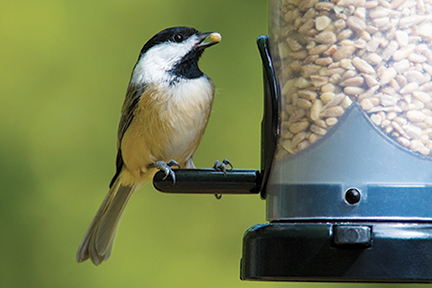
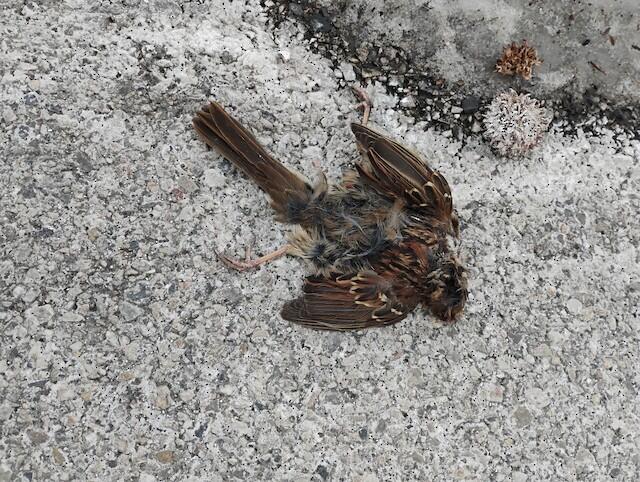
This has created yet another “perfect storm” of conditions for our feathered friends. They are congregating in much larger numbers than usual in places where we drivers are not used to encountering them. As they are generally malnourished at present, they’re less willing to abandon a potential food source, and their reaction times are slower than normal. Even so, given their feeding habits, these species typically fly within a few feet of the ground—right at car level, unlike our resident chickadees, nuthatches, titmice, and woodpeckers, who tend to drop down from greater heights to come to our feeders. And we humans have been battling cabin fever for over a week, making us increasingly eager to get out and about and perhaps a bit lead-footed on the gas. Put all of this together and there have been unprecedented numbers of small birds becoming casualties of car strikes over the past week or so.
All it takes is a bit of awareness of the problem to help lessen the consequences. Watch for exposed grassy edges, give a wide berth around them when it’s safe to do so, and, in general, drive a bit slower than usual, knowing that you can’t necessarily see the flock ahead behind the piles of plowed snow. Make family members, neighbors, and friends aware, too; bird enthusiast or not, nobody feels good about hitting a wild animal—especially one that is doing everything it can to survive in these extreme outdoor conditions. For a myriad of anthropogenic reasons, 70% of North American birds are already on the decline; let’s not make a bad situation worse by hitting birds in our haste to get from Point A to Point B. And keep your feeders full - you really are helping to save birds' lives!